




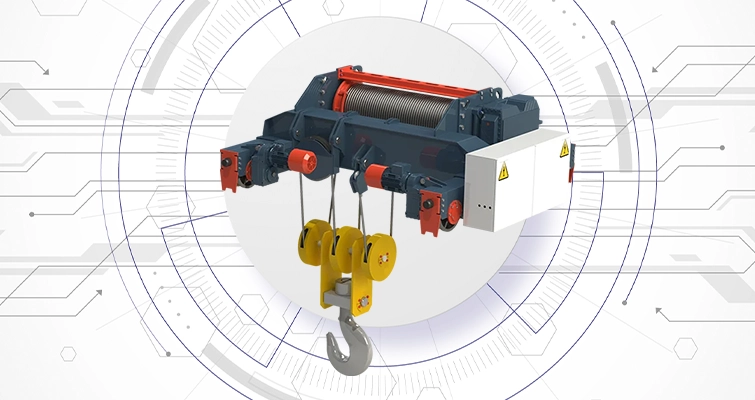
How Is Overhead Travelling Crane Capacity Determined?
How Is Overhead Travelling Crane Capacity Determined?
Selecting the Correct Crane Tonnage Based on Load Weight, Lifting Attachments, Safety Factors and Operating Conditions
When investing in an overhead travelling crane, the first question is usually how many tonnes the crane needs to lift. Companies often define their requirement as a 5-ton, 10-ton, 20-ton or higher-capacity crane. However, determining the correct crane capacity involves much more than simply identifying the weight of the product to be handled.
If crane capacity is selected incorrectly, the system may either fail to meet production requirements or result in an unnecessarily large and expensive investment.
For example, selecting an 8-ton crane to handle an 8-ton machine component may not be appropriate. The weight of lifting beams, chain slings, electromagnets, clamps and other below-the-hook lifting devices also acts on the crane hook. Dynamic effects, load distribution, operating frequency, load geometry and future production requirements must also be included in the capacity calculation.
For this reason, the following factors should be evaluated together when determining overhead travelling crane capacity:
- Maximum load weight
- Average load weight
- Weight of lifting attachments
- Centre of gravity of the load
- Load geometry
- Lifting frequency
- Crane duty class
- Hoisting and travelling speeds
- Dynamic load effects
- Tandem lifting requirements
- Future capacity increases
- Building support structure
- Crane span and wheel loads
Based in Konya, Eser Vinç does not determine crane capacity according to nominal load alone. The production process, lifting equipment, operating intensity, building structure and long-term requirements are evaluated together to develop a project-specific crane solution.
This comprehensive guide explains how overhead travelling crane capacity is calculated, which loads must be included, the consequences of selecting the wrong tonnage and how capacity determination should be managed in different industries.
What Is Overhead Travelling Crane Capacity?
Overhead travelling crane capacity is the maximum total load that the crane can safely lift under specified operating conditions.
Capacity is generally expressed in tonnes.
Common examples include:
- 3.2-ton overhead travelling crane
- 5-ton overhead travelling crane
- 10-ton overhead travelling crane
- 20-ton overhead travelling crane
- 50-ton overhead travelling crane
The important point is that the stated capacity refers not only to the weight of the product being transported but to the total suspended load acting on the hook.
The total hook load generally consists of:
Handled load + lifting attachment + auxiliary connection equipment
For example, if a 9-ton load is transported using a special lifting beam weighing 1 tonne, the total hook load reaches 10 tonnes.
Is Crane Capacity the Same as the Weight of the Load?
Not always.
There may be a significant difference between the net weight of the product and the total weight that the crane must lift.
For example:
- Product weight: 7,500 kg
- Lifting beam weight: 800 kg
- Chain sling weight: 150 kg
- Auxiliary below-the-hook equipment: 100 kg
The total hook load is:
7,500 + 800 + 150 + 100 = 8,550 kg
In this case, selecting crane capacity based only on the 7.5-ton product weight would be incorrect.
The weight of all equipment attached to the hook must be included in the total capacity calculation.
Why Must Crane Capacity Be Determined Correctly?
Capacity directly affects the safety and efficiency of the crane.
If a crane with insufficient capacity is selected, the following problems may occur:
- Overloading risk
- Excessive motor stress
- Inadequate braking performance
- Premature rope and drum wear
- Excessive stress in the bridge girders
- Increased wheel loads
- Overloading of the building structure
- Frequent activation of safety systems
- Production interruptions
If a crane with unnecessarily high capacity is selected:
- Initial investment cost may increase
- Crane self-weight may rise
- Loads transferred to columns and runway beams may increase
- A stronger building structure may be required
- Motor and gearbox costs may increase
- Unnecessary energy and equipment investment may occur
The correct approach is to select a capacity that safely meets the actual requirement without creating unnecessary oversizing.
Which Loads Must Be Considered in the Capacity Calculation?
Maximum Product Weight
The first value to determine is the actual weight of the heaviest product to be lifted.
This value should be verified using:
- Technical drawings
- Manufacturer data
- Weighing records
- Material density calculations
- Product specifications
Estimated weight data can cause serious errors in crane selection.
The difference between estimated and actual weight may be significant in:
- Large steel structures
- Machine bodies
- Moulds
- Coils
- Concrete elements
- Heavy industrial equipment
Weight of Lifting Attachments
The weight of lifting attachments is an integral part of the capacity calculation.
Common lifting attachments include:
- Steel wire rope slings
- Chain slings
- Polyester webbing slings
- Lifting beams
- C-hooks
- Coil lifting attachments
- Electromagnets
- Vacuum lifters
- Plate gripping systems
- Clamps
- Grabs
- Special lifting attachments
Large lifting beams and electromagnetic systems may weigh hundreds of kilograms or several tonnes.
Their weight must never be ignored.
Hook Block Weight
The hook block is part of the crane itself and is generally considered within the hoisting mechanism design.
However, in special projects, the hook block, lower sheave assembly and auxiliary equipment may need to be reviewed separately.
Auxiliary Equipment Attached to the Load
The following items may also increase total suspended weight:
- Pallets
- Transport frames
- Packaging
- Protective crates
- Assembly platforms
- Connection equipment
These elements should also be included in the hook load calculation.
How Is a Safety Margin Included in Crane Capacity?
A safety margin should not be understood as simply adding an arbitrary percentage to the load.
Engineering safety is provided through:
- Applicable standards
- Material strength calculations
- Dynamic factors
- Fatigue assessment
- Component selection
- Structural design factors
However, possible small future increases in load weight should also be considered when defining the operating requirement.
For example, if the maximum total hook load is 9.6 tonnes, a 10-ton crane may operate too close to its limit. A higher capacity may need to be evaluated if there is a realistic possibility of:
- Increased product weight
- A change in lifting attachment
- Manufacturing tolerances
- Additional lifting equipment
However, selecting a crane with a much higher capacity simply for reassurance may not be an economically or technically correct decision.
Safe crane capacity should be determined according to the actual operating scenario.
What Is a Dynamic Load?
When the crane starts lifting or stops a load, the system is not exposed only to static weight.
Acceleration, deceleration, sudden stopping, load sway and rope tension create additional forces. These are referred to as dynamic load effects.
Dynamic effects may increase in the following situations:
- Fast lifting
- Sudden braking
- Harsh starting
- A load sticking to the floor and breaking free suddenly
- Side pulling
- Slack rope conditions
- Transporting a swinging load
- Aggressive control input by the operator
For this reason, cranes are not designed only according to static load weight.
The motor, brake, gearbox, rope, bridge girders and connections must be engineered for dynamic operating conditions.
Does the Centre of Gravity Affect Capacity Selection?
Yes.
The position of the load’s centre of gravity is as important as its total weight.
If the centre of gravity is not balanced directly below the hook:
- The load may tilt
- One sling may carry more load than another
- The lifting beam may be loaded unevenly
- The hook may be subjected to off-axis loading
- Load control may become difficult
Correct lifting points are especially important for long, asymmetrical or irregularly shaped loads.
Examples include:
- Machine bodies
- Long steel structures
- Moulds
- Trailer chassis
- Tanks
- Pipe assemblies
- Agricultural machinery frames
- Precast concrete elements
For such loads, weight information alone is not sufficient. The centre of gravity and lifting points must also be analysed technically.
Why Is Load Distribution Important?
In multi-point lifting operations, the load may not be distributed equally between all sling legs.
A four-leg sling arrangement may theoretically appear to divide the load equally between four legs. In practice, some legs may carry more load due to:
- Load geometry
- Differences in connection-point levels
- Unequal sling lengths
- Centre-of-gravity position
This must be considered in the lifting calculation.
In addition, the tension in each sling leg increases as the sling angle moves closer to the horizontal.
The following should therefore be evaluated together:
- Sling length
- Connection angle
- Lifting-point position
- Use of lifting beams
- Load geometry
How Does Sling Angle Affect Capacity?
The closer the slings are to vertical, the more controlled the load distribution will be.
As the sling angle approaches the horizontal, the tensile force in the sling legs increases.
The same load generates different sling forces when lifted:
- Vertically
- At a 60-degree angle
- At a 45-degree angle
- At a lower angle
Therefore, it is necessary to check not only crane capacity but also:
- Sling working load limit
- Lifting attachment capacity
- Connection angle
- Lifting-point strength
An incorrect sling angle may overload lifting equipment even when the crane itself appears to have sufficient capacity.
Difference Between Average Load and Maximum Load
Crane capacity is determined according to the maximum load. However, average load is also important for duty class and equipment service life.
For example, a 10-ton crane that:
- Rarely lifts 10 tonnes
- Usually lifts 2 tonnes
has one operating profile.
Another 10-ton crane that continuously handles loads between 8 and 10 tonnes is subjected to much more demanding mechanical and electrical conditions.
Crane capacity and crane duty class must therefore be evaluated together.
Capacity defines the maximum safe load. Duty class defines how frequently and intensively those loads will be handled.
Should Future Production Requirements Be Considered?
Yes.
A crane is a long-term investment. Selecting capacity only according to current products may cause the system to become insufficient in the future.
The following questions should be considered during the project stage:
- Will heavier products be manufactured?
- Will new machinery be installed?
- Will the production line be expanded?
- Will lifting attachments change?
- Will an additional shift be introduced?
- Will product dimensions increase?
- Will the crane be used in other departments?
Future growth expectations should be realistic.
Increasing capacity excessively based on uncertain possibilities may increase both crane and building costs unnecessarily.
Capacity Selection for Single-Girder Overhead Cranes
Single-girder overhead travelling cranes are generally preferred for low- and medium-capacity applications.
Their main advantages include:
- Lower self-weight
- More economical manufacturing
- Lower wheel loads
- Easier installation
- Lower loads on the building structure
However, the suitability of a single-girder crane is not determined by capacity alone.
The following criteria are also important:
- Crane span
- Lifting height
- Duty class
- Operating frequency
- Hook approach
- Building height
With proper engineering design, single-girder systems can provide an efficient solution for many industrial applications.
Capacity Selection for Double-Girder Overhead Cranes
Double-girder overhead travelling cranes are generally preferred for:
- High lifting capacities
- Long spans
- Heavy-duty operating conditions
- High lifting heights
- Special lifting attachments
In a double-girder system, the hoisting trolley travels on two main girders.
This structure may provide advantages such as:
- High load-bearing strength
- Improved hook approach
- Possibility of maintenance platforms
- Special trolley designs
- Suitability for heavy-duty service
However, selecting a double-girder crane does not automatically mean that it is safer or more appropriate.
Capacity, span, duty class and building structure must be evaluated together.
Does Crane Span Affect Capacity Calculation?
Yes.
Crane span is the distance between the two runway rails.
As the span increases, the main bridge girders are exposed to greater bending effects.
Two cranes with the same lifting capacity but spans of:
- 10 metres
- 30 metres
cannot use the same bridge design.
As span increases:
- Girder depth may increase
- Crane self-weight may rise
- Wheel loads may change
- Deflection control becomes more critical
- Loads transferred to the building may increase
Capacity calculations cannot therefore be separated from crane span.
Does Lifting Height Affect Capacity?
Lifting height does not directly change the nominal lifting capacity, but it affects the selection of the hoisting mechanism.
Higher lifting heights may require:
- Longer wire rope
- Larger rope drum
- Longer motor operating time
- Different gearbox ratio
- Longer power cables
- Different hook block design
Longer lifting travel also increases cycle time.
Capacity, lifting height and lifting speed should therefore be engineered together.
What Is Tandem Lifting?
Tandem lifting is the handling of one load using two separate cranes or two hoisting mechanisms operating together.
This method is commonly used for:
- Very long loads
- Large machinery
- Heavy steel structures
- Boilers and tanks
- Large moulds
- Precast concrete elements
It should not be assumed that the load will be divided equally between the two cranes.
One crane may carry more load than the other because of:
- Centre-of-gravity position
- Load geometry
- Speed differences
- Connection points
- Synchronisation errors
Tandem lifting projects require:
- Load-distribution calculations
- Synchronous speed control
- A common control system
- Load monitoring
- Communication systems
- A written operating procedure
Capacity in Cranes with Two Hoisting Mechanisms
Some overhead travelling cranes are equipped with two separate hoisting units.
For example:
- 20-ton main hoist
- 5-ton auxiliary hoist
In these systems, the following must be evaluated:
- Individual capacity of each hoist
- Whether both hoists may operate simultaneously
- Their location on the trolley
- Loads transferred to the bridge
- Electrical power requirements
The capacities of two hoists cannot always be added directly and used as the total crane capacity.
The trolley and load-bearing structure must be designed for combined operation.
What Is Eccentric Loading?
Eccentric loading may occur when a load is handled away from the hook centreline or trolley axis.
This can cause:
- Side forces on the hook block
- Uneven rope tension
- Unequal trolley wheel loads
- Torsion in the bridge structure
- Uncontrolled rotation of the load
Crane hooks are primarily designed to carry vertical loads.
They should not be used for:
- Pulling loads along the ground
- Inclined lifting
- Horizontal loading
Why Is Side Pulling Dangerous?
Side pulling occurs when the hook is not positioned directly above the load’s centre of gravity before lifting begins.
This may cause:
- Side loading of the wire rope
- Dragging of the load along the floor
- Sudden breakaway movement
- Severe load swing
- Disturbance of rope winding on the drum
- Horizontal forces acting on the crane structure
Even if the crane has sufficient nominal capacity, side pulling creates a serious safety risk.
The hook must be positioned above the load’s centre of gravity before lifting.
What Is an Overload Protection System?
An overload protection system helps prevent the crane from lifting a load above its permitted capacity.
The system may operate using:
- Load cells
- Rope-force sensors
- Electronic load limiters
- Mechanical load limiters
- Control units
When an overload is detected, the system may:
- Stop the upward lifting movement
- Warn the operator
- Activate visual and audible alarms
- Display load information on a screen
However, overload protection does not replace correct crane capacity selection.
The crane must already be engineered according to the actual operating load.
Should a Load Indicator Be Used?
A load indicator allows the operator to view the instantaneous load suspended from the hook.
It may provide significant advantages in:
- Variable-weight lifting
- Scrap handling
- Coil and plate operations
- Special lifting operations
- Tandem lifting
- Heavy manufacturing facilities
A load-monitoring system may also record crane-capacity utilisation data.
This information is valuable for:
- Maintenance planning
- Usage analysis
- Duty-class evaluation
- Overload monitoring
How Does the Building Structure Affect Crane Capacity?
Crane capacity is not limited only by the crane’s own structural strength.
Loads generated by the crane are transferred to the building.
These loads include:
- Crane self-weight
- Lifted load
- Trolley weight
- Dynamic effects
- Braking forces
- Horizontal travel forces
- Wheel reactions
The building columns, runway beams, connections and foundations must be capable of supporting these forces.
If a high-capacity crane is to be installed in an existing factory, a structural assessment is required.
If the building is insufficient, the following solutions may be considered:
- Column reinforcement
- Replacement of runway beams
- Independent crane support structure
- Foundation reinforcement
Can the Capacity of an Existing Crane Be Increased?
It may be possible in some cases, but replacing only the hoisting motor is not sufficient.
Before increasing capacity, the following components must be inspected:
- Main bridge girders
- Hoisting trolley
- Motor
- Gearbox
- Brake
- Wire rope
- Drum
- Hook block
- Wheels
- Rails
- Electrical system
- Building columns
- Runway beams
- Foundations
If the structural and mechanical components are not suitable for the new capacity, increasing the capacity is not safe.
In some projects, modernising the existing crane may be possible. In others, investing in a new crane may be safer and more economical.
Does Increasing Capacity Affect Crane Speed?
Yes, it can.
If a heavier load is lifted using the same motor power, the lifting speed may decrease or the motor may be overloaded.
When increasing capacity, the following must be evaluated together:
- Motor power
- Gearbox ratio
- Drum diameter
- Rope reeving
- Brake torque
- Electrical power supply
When high capacity and high lifting speed are required at the same time, motor power and system cost may increase significantly.
Crane Capacity Selection by Industry
Machinery Manufacturing
Machine bodies, frames, motors and large components are handled.
Capacity should be based on:
- The heaviest machine component
- Assembly equipment
- Products planned for future production
Agricultural Machinery Manufacturing
The weights of combine harvester, trailer, plough, seed drill and other agricultural machinery frames may vary significantly.
Centre-of-gravity analysis is particularly important because many of these loads are long and asymmetrical.
Steel Construction
Profiles, columns, beams and welded modules are handled.
For long products, lifting beams and load distribution are decisive factors in the capacity calculation.
Iron and Steel Plants
Coils, plates, profiles and heavy metal products may be transported.
In such facilities, duty class and operating intensity are as important as lifting capacity.
Foundries
Moulds, ladles and cast products are handled.
High temperatures and critical safety conditions may require special crane designs.
Marble and Natural Stone
Marble blocks are heavy because of their high material density.
The block weight, lifting clamp and safe attachment system must be evaluated together.
Precast Concrete Plants
The weight of concrete elements must be calculated accurately according to volume and density.
The mould and lifting beam weights must also be added to the total load.
Logistics and Warehousing
Load weights may vary.
Capacity selection should consider:
- The heaviest load
- Lifting frequency
- Storage layout
- Travel distances
Maintenance Workshops
Maintenance cranes may be used intermittently but may lift heavy and critical components such as:
- Motors
- Moulds
- Machine parts
Capacity should therefore be based on the heaviest maintenance component in the facility.
Common Mistakes When Determining Overhead Crane Capacity
Considering Only Product Weight
The weight of lifting beams, slings and special attachments must also be included.
Using Estimated Weight
Actual weight should be verified through technical documentation or weighing.
Ignoring Future Products
Expansion of the production line may cause the crane to become insufficient within a short period.
Selecting Excessive Capacity
Unnecessarily high capacity may increase both crane and building costs.
Ignoring Crane Duty Class
Cranes with the same lifting capacity must be designed differently for different operating intensities.
Failing to Calculate the Centre of Gravity
Asymmetrical loads may cause unbalanced lifting and overstressing of lifting equipment.
Ignoring Sling Angles
Incorrect sling angles may significantly increase forces in sling legs.
Failing to Check Building Capacity
A high-capacity crane should not be installed in an existing structure without a structural assessment.
Assuming Equal Load Distribution in Tandem Lifting
The load does not always divide equally between two cranes.
Correct Capacity Analysis with Eser Vinç
Overhead travelling crane capacity should not be selected randomly from a catalogue.
Every facility has different:
- Maximum load
- Average load
- Lifting attachment
- Load geometry
- Operating frequency
- Crane span
- Lifting height
- Building structure
- Future production targets
Eser Vinç performs a technical site survey and operational analysis before the project to determine the correct crane capacity.
Services include:
- On-site technical survey
- Maximum-load analysis
- Lifting-attachment calculation
- Centre-of-gravity assessment
- Sling and lifting-beam selection
- Capacity calculation
- Duty-class determination
- Crane-span calculation
- Wheel-load analysis
- Single-girder and double-girder selection
- Motor and gearbox selection
- Brake-system design
- Rope and drum calculation
- Electrical and automation engineering
- Overhead travelling crane manufacturing
- Installation and commissioning
- Load testing
- Operator training
- Periodic maintenance
- Modernisation and technical service
With its manufacturing capability in Konya, Eser Vinç develops overhead travelling crane systems for different capacities and operating conditions throughout Türkiye and international markets.
Frequently Asked Questions
How is overhead travelling crane capacity determined?
The maximum load, lifting attachments, duty class, load geometry, dynamic effects and building load-bearing capacity are evaluated together.
Is a 10-ton crane sufficient for a 9-ton load?
It depends on the weight of the lifting beam and auxiliary equipment. The total hook load may exceed 10 tonnes.
Is lifting-beam weight included in crane capacity?
Yes. The weight of all equipment suspended from the hook must be included in the total load.
Should a higher-capacity crane be selected for safety?
The required capacity should be determined using proper engineering calculations and reasonable operating allowances. Excessively high capacity may increase cost and building loads.
Are crane capacity and duty class the same?
No. Capacity defines the maximum load, while duty class defines operating intensity.
Can the capacity of an existing crane be increased?
It may be possible following technical analysis. The bridge, trolley, motor, brake, rope, rails and building support structure must be inspected.
Can one load be lifted using two cranes?
Yes, tandem lifting is possible. However, load distribution and synchronisation must be determined through engineering calculations.
Why is the centre of gravity important?
If it is not determined correctly, the load may tilt, sling forces may become unbalanced and serious safety risks may occur.
Is an overload protection system necessary?
It is an important safety system, but it does not replace correct crane capacity calculation.
What information is required for a quotation?
The following information is useful for an initial evaluation:
- Maximum load weight
- Average load weight
- Type and weight of lifting attachment
- Load dimensions
- Crane span
- Lifting height
- Daily operating time
- Number of lifts per hour
- Internal building height
- Facility location
Conclusion
Overhead travelling crane capacity should not be determined only by the weight of the product being transported.
A correct capacity calculation should consider:
- Maximum load
- Average load
- Weight of lifting beams and slings
- Lifting attachments
- Centre of gravity
- Load geometry
- Dynamic effects
- Crane duty class
- Crane span
- Lifting height
- Building support structure
- Future production requirements
Insufficient capacity may create safety risks, failures and production downtime. Excessive capacity may increase investment cost, crane self-weight and the loads transferred to the building.
Eser Vinç manages overhead travelling crane, gantry crane and overhead crane projects from technical survey and engineering to manufacturing, installation, load testing and after-sales services. By calculating capacity according to the facility’s actual lifting requirements, the company develops safe, efficient and long-lasting crane systems.
The Right Crane Capacity for Your Facility with Eser Vinç
For new overhead travelling crane investments, existing-crane capacity analysis, tandem lifting applications, custom lifting-beam design and crane modernisation, companies can obtain technical support from Eser Vinç’s specialist engineering team.