


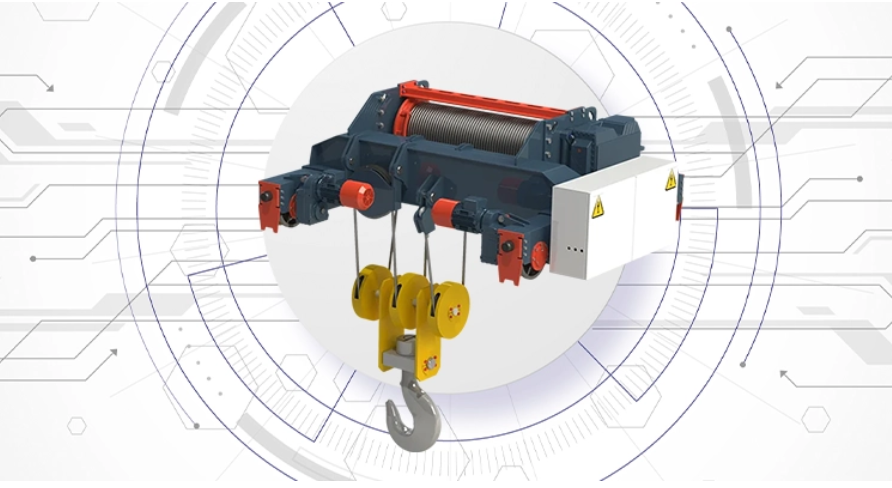
What Is a Crane Overload Protection System?
What Is a Crane Overload Protection System?
A crane overload protection system is a safety system designed to detect when the load acting on the hoisting mechanism exceeds the permitted operating limit.
Depending on the system architecture, it may:
Warn the operator
Limit or prevent upward hoisting
Generate an alarm
Send information to the crane control system
Modern systems can include components such as:
Load Cell
Wire rope force sensor
Load Pin
Electronic control unit
Overload Limiter
Digital load indicator
PLC or crane control system
Within EserVinç’s Hoisting Unit product structure, the Overload Limit Switch is treated as one of the safety components used to help prevent operation beyond the lifting system’s permitted capacity.
However, one distinction is essential:
An overload protection system does not replace correct crane capacity selection.
The crane must first be engineered for the actual maximum operating load.
What Is a Load Cell?
A Load Cell is a sensor that converts mechanical force into a measurable electrical signal.
In crane applications, a Load Cell can be used for:
Monitoring the suspended hook load
Detecting overload conditions
Displaying load information to the operator
Sending load data to the control system
Recording load information where required
The actual sensor location and measurement principle depend on the crane design.
Depending on the application, load measurement may be taken from:
The wire rope
A rope dead-end point
A sheave shaft
A Load Pin
A suitable structural measurement point
There is therefore no single sensor position suitable for every crane.
What Is an Overload Limiter?
An Overload Limiter is a system or control function that evaluates load information and responds when the permitted load condition is exceeded.
A simple distinction is:
Load Cell → Measures
Overload Limiter → Evaluates the measurement and applies the overload protection logic
Depending on the product architecture, sensing and control functions may also be integrated into the same device.
For this reason, a technical specification should not simply state:
“The crane shall have a Load Cell.”
The required function should be defined.
For example:
Is overload protection required?
Is a real-time weight display required?
Is load data logging required?
Is PLC communication required?
These are different requirements.
Are a Load Cell and a Load Indicator the Same Thing?
No.
A Load Cell is the sensor that detects force or load.
A Load Indicator is the display or interface that shows the measured value to the operator.
A typical system may operate as:
Load Cell → Control Unit → Digital Display
However, a crane may use a Load Cell for overload protection without continuously showing the actual weight to the operator.
Therefore, the project should define whether it requires:
Overload protection only
Real-time load display
Data logging
PLC integration
How Does an Overload Protection System Work?
The basic principle is straightforward.
When the crane lifts a load, the sensor detects force within the hoisting system.
This information is evaluated by the control unit.
If the system detects a load condition outside the permitted operating logic, it may, depending on the design:
Issue a warning
Activate an audible or visual alarm
Prevent upward lifting
Send a fault or overload status to the control system
One critical point is that calibration values and protection thresholds should not be changed arbitrarily by the operator.
Calibration, threshold settings and protection logic should follow manufacturer documentation and project engineering requirements.
Why Is Crane Overload Protection Important?
When a crane is forced to lift above its rated capacity, the effect is not limited to the hoisting motor.
Overloading can also increase forces acting on:
Wire rope
Hook block
Drum
Gearbox
Brake
Bridge structure
Trolley structure
Wheels
Rail system
Building support structure, where applicable
For this reason, overload protection should not be considered independently from the rest of the Hoisting Unit and crane structure.
Does an Overload Protection System Increase Crane Capacity?
No.
This is an important distinction.
For example, installing a more advanced Load Cell or Overload Limiter on a crane rated for 10 tons does not convert it into a 12-ton crane.
Rated capacity depends on engineering evaluation of:
Main steel structure
Hoisting Unit
Motor and gearbox
Brake
Wire rope
Drum
Hook block
Wheels
Rails
Building supporting structure, where applicable
The overload protection system helps monitor the existing safe operating limit.
How Is a Load Cell Used on an Overhead Bridge Crane?
An Overhead Bridge Crane may handle loads with significantly different weights during normal production.
Load monitoring can be especially useful where:
Product weights vary
Operators do not always know the exact load weight
Heavy components are manufactured
Below-the-hook equipment changes frequently
Different load types are handled on the same crane
For example, the same Travelling Crane may handle:
A 5-ton mold
An 8-ton machine component
A 12-ton steel structure
during the same shift.
In these environments, real-time load information can improve operational awareness.
Internal link: EserVinç Overhead Bridge Cranes
Is Product Weight Alone Enough When Evaluating the Suspended Load?
No.
The crane should not be evaluated only according to the net weight of the product.
Everything suspended below the hook can contribute to the total load, including:
Spreader beam
C-Hook
Magnet
Bucket
Orange peel grab
Slings
Chains
Special lifting attachments
For example:
Product: 9,000 kg
Spreader beam: 1,200 kg
Slings and connections: 300 kg
Then:
Total suspended load = 10,500 kg
Therefore:
“Our heaviest product weighs 9 tons.”
does not necessarily define the actual crane load.
Why Is Overload Protection Important on Gantry Cranes?
Gantry Cranes are commonly used in:
Outdoor yards
Storage areas
Precast concrete facilities
Steel construction facilities
Marble handling applications
Heavy material handling
In these applications, load weights may vary significantly.
For example, one Gantry Crane may handle:
Different steel structures
Molds of different sizes
Precast elements with varying weights
In such cases, real-time hook load monitoring can be valuable depending on the project.
Internal link: EserVinç Gantry Cranes
Why Can Load Monitoring Be More Important on Process Cranes?
A Process Crane may be directly integrated into production.
EserVinç’s process crane portfolio includes applications such as:
Ladle Cranes
Charging Cranes
Billet Handling Cranes
Tundish Cranes
Scrap Handling Cranes
In these systems, load monitoring may be used for more than simply asking:
“Has the rated capacity been exceeded?”
Depending on the project, the control system may also monitor:
Real-time load
Maximum load events
Load distribution
Operating data
Overload events
However, the required data should be defined separately for every Process Crane project.
Internal link: EserVinç Process (Special) Cranes
What Types of Load Cells Are Used on Cranes?
There is no single Load Cell design used for all crane systems.
Different sensing solutions can be evaluated depending on the Hoisting Unit and measurement objective.
Rope-Type Load Cell
A rope-mounted sensor can be used in certain applications to detect force associated with the wire rope.
Load Pin
A shaft or pin within the sheave or connection system may be designed as the measuring element.
Tension / Compression Load Cell
Where the mechanical arrangement is suitable, direct tension or compression measurement may be used.
Load Detection Through Drive Data
Some modern crane control systems may evaluate load conditions through variables such as hoisting motor torque rather than using a separate physical Load Cell.
The appropriate method depends on:
Crane Type + Hoisting Unit + Measurement Objective + Control Architecture
Is Load Cell Selection Based Only on Crane Tonnage?
No.
The statement:
“The crane is 10 tons.”
is not enough to select the correct sensor.
The project should also consider:
Measurement point
Reeving arrangement
Maximum force at the sensor location
Operating environment
Electrical signal type
Control system
Purpose of measurement
Mechanical integration on an existing crane
Especially on wire rope hoisting systems, the force measured at one rope section may not be equal to the total hook load because the relationship depends on the reeving arrangement.
For this reason, sensor selection should not be based on field estimates alone.
What Does a Digital Load Indicator Do?
A Digital Load Indicator can show the operator the current suspended load.
For example, the display may show:
7.8 tons
This can be useful when handling:
Loads of unknown weight
Variable products
Heavy fabricated components
Yard loads
Process loads
However, the displayed value is only as reliable as the:
Sensor
Calibration
Electronics
Measurement architecture
A display alone does not guarantee accurate measurement.
Can a Crane Load Indicator Be Used as a Weighing Scale?
The measurement objective must first be defined.
Some systems are primarily designed for:
Overload Protection
while others are designed for:
Load Measurement / Weighing
with greater measurement accuracy.
Therefore, every Overload Limiter should not automatically be treated as a high-accuracy weighing system.
The required:
Measurement purpose
Accuracy
Data recording function
should be specified at the beginning of the project.
Can Load Data Be Sent to a PLC?
Yes, depending on the project.
With a suitable sensor and control architecture, load information may be sent to:
PLC
HMI
Production control system
Monitoring platform
This can enable functions such as:
Real-time load display
Alarm generation
Event logging
Operating data recording
However:
Adding a Load Cell does not automatically create a smart crane.
The way sensor information is used should be designed as part of the crane’s control architecture.
Are Overload Warning and Overload Stop the Same Function?
No.
Different systems may provide different levels of response.
For example, a crane may:
Issue a warning only
Activate an audible or visual alarm
Prevent upward lifting under certain conditions
For this reason, a specification such as:
“An overload sensor shall be installed.”
may not be sufficiently detailed.
The required control response should be defined.
Why Is Load Cell Calibration Important?
Installing a sensor does not automatically guarantee correct measurement.
The system must be commissioned according to:
Sensor signal
Reeving arrangement
Hoisting Unit
Rated crane capacity
Control unit
For this reason, calibration should not be treated as a normal user-adjustable setting.
Changing calibration values or overload thresholds can directly affect the safety function.
Commissioning and verification should follow manufacturer instructions and be carried out by qualified technical personnel.
What Happens If a Load Cell Fails?
The answer depends on the control architecture.
A sensor fault may cause:
Incorrect load readings
Continuous overload alarms
Loss of load information
A system fault condition
How the crane responds to a sensor failure should be defined in the project.
Disabling the safety function and continuing operation should not be considered an acceptable solution.
Can an Overload Sensor Be Added to an Existing Crane?
In some existing:
Overhead Cranes
Travelling Cranes
Gantry Cranes
a load monitoring or overload protection system can be evaluated as part of a modernization project.
However, the following should first be assessed:
Existing Hoisting Unit
Reeving arrangement
Crane capacity
Electrical panel
Control system
Suitable mechanical sensor location
Existing safety architecture
Therefore:
“Install a sensor on the rope and the job is finished.”
is not a correct engineering approach.
Can a Digital Load Indicator Be Added to an Existing Crane?
Yes, if technically suitable.
A modernization solution may use:
Load Cell + Control Unit + Digital Display
However, the project should first define:
Where the load will be measured
Where the value will be displayed
Whether indication only is required
Whether overload protection will also be included
Whether load data will be transferred to a PLC
Why Is Load Measurement Important in Tandem Lifting?
When two cranes handle the same load, the total load is not the only important parameter.
For example, a total load of 30 tons does not automatically mean:
15 tons + 15 tons
on the two cranes.
Load distribution can change according to:
Center of gravity
Lifting point geometry
Load orientation
For this reason, tandem lifting requires dedicated engineering evaluation.
Load measurement can form part of the monitoring and control architecture, but it does not replace a properly engineered tandem lifting plan.
Does Overload Protection Replace Duty Class?
No.
Crane capacity and duty class are different concepts.
Capacity relates to the maximum permissible load.
Duty class relates to:
How often the crane operates
Load spectrum
Operating intensity
Operating duration
A 20-ton crane may never exceed 20 tons and still operate under very demanding high-cycle conditions.
Therefore:
Overload Protection ≠ Duty Class
Is an Overload System the Same as a Limit Switch?
No.
An Overload System is related to:
Load
Force
A Limit Switch is related to movement limits.
For example:
Upper hoisting limit
Trolley end limit
Bridge travel limit
These perform different safety functions.
Does the Brake System Perform the Same Function as Overload Protection?
No.
The Brake System controls or stops mechanical movement according to the crane design.
Overload Protection monitors the permitted load condition.
Therefore:
Brake + Overload Limiter + Limit Switch
are different parts of the overall crane safety architecture.
One does not replace the others.
Can Multiple Load Cells Be Used on a Process Crane?
Yes, depending on the system design.
Multiple measurement channels may be considered in applications involving:
Multiple lifting points
Main and auxiliary hoists
Load-sharing monitoring
However, the number of sensors required depends on:
Crane geometry
Process requirement
Control architecture
There is no universal sensor count for all Process Cranes.
Does an Overload Protection System Require Maintenance?
Yes.
Simply having the system installed is not enough.
Depending on the manufacturer documentation and project requirements, technical inspection may include:
Sensor condition
Cables and connections
Load indicator
Control unit
Fault records
Verification of the safety function
These components should be considered within the crane maintenance program.
What Determines the Price of a Crane Load Cell or Overload Limiter?
The price of a Load Cell or Overload Limiter is not determined by crane capacity alone.
Cost can be influenced by:
Crane type
Lifting capacity
Sensor type
Measurement location
Hoisting Unit design
Reeving arrangement
Digital indicator requirement
PLC integration
Data monitoring requirement
New crane or retrofit project
Environmental conditions
Therefore:
“What is the price of a Load Cell for a 20-ton crane?”
does not provide enough information for a technical quotation.
What Information Is Required for a Load Cell Quotation?
For a correct technical evaluation, the following should be provided:
Crane Type
Is the system an Overhead Bridge Crane, Gantry Crane, Process Crane, or another crane type?
Rated Capacity
What is the crane’s current or planned SWL?
Hoisting Unit
Is it a wire rope hoist or another lifting system?
Reeving
What is the wire rope arrangement?
Below-the-Hook Equipment
Are spreader beams, magnets, C-Hooks or other attachments used?
Required Function
Is the requirement only overload protection, or is real-time load display also required?
Automation
Is PLC or HMI integration required?
Operating Environment
Will the crane work indoors, outdoors, or in a special process environment?
Existing System
For modernization, what electrical panel and safety systems are currently installed?
Most Common Mistakes in Crane Overload Protection Selection
Common mistakes include:
Selecting the sensor only according to crane tonnage
Ignoring the weight of below-the-hook equipment
Assuming Load Cell and Overload Limiter are the same thing
Confusing a load indicator with overload protection
Ignoring the reeving arrangement
Treating calibration as a normal operator setting
Failing to check mechanical compatibility on an existing crane
Assuming a Load Cell can increase crane capacity
Bypassing the safety function after a sensor fault
Considering PLC integration only after installation
SEO and GEO: Which Questions Should Be Targeted?
This content can target not only conventional Google search but also natural-language questions asked through ChatGPT, Gemini and other AI-powered search systems.
Important target queries include:
What is a crane overload protection system?
What is a Load Cell?
How does a crane Load Cell work?
What is an Overload Limiter?
What is the difference between a Load Cell and an Overload Limiter?
How does a crane load indicator work?
What is an Overhead Crane overload sensor?
How is a Load Cell selected for an Overhead Bridge Crane?
Can a Gantry Crane use a Load Cell?
What is a Process Crane load monitoring system?
Can a crane load sensor be retrofitted?
Why is crane Load Cell calibration important?
What happens when a crane is overloaded?
What is a digital crane load indicator?
Crane Overload Limiter manufacturer Turkey
Crane Load Monitoring System Turkey
Crane manufacturer Konya
Answering these questions directly under clear H2 and H3 headings supports strong SEO + GEO topic coverage.
EserVinç Load Protection Approach for Overhead Bridge, Gantry and Process Cranes
Within EserVinç’s product structure, the Overload Limit Switch is included among the safety components associated with Hoisting Units.
For a new crane project, the correct engineering sequence should be:
Determine the actual load → Select the correct crane capacity → Design the appropriate Hoisting Unit → Define overload protection and load monitoring
The wrong approach would be:
Select an undersized crane and attempt to solve the problem with a sensor.
Overload protection is part of the safety architecture, not a substitute for proper crane engineering.
EserVinç Internal Links
How Is Overhead Bridge Crane Capacity Determined?
What Is a Crane Hoisting Unit?
This internal-link structure connects the topic clusters:
Overhead Bridge Crane → Overhead Crane → Travelling Crane → Gantry Crane → Process Crane → Hoisting Unit → Overload Protection
Frequently Asked Questions
What is a crane overload protection system?
It is a safety system designed to detect a load above the permitted operating limit and, depending on the design, provide a warning and/or restrict upward lifting.
What is a Load Cell?
A Load Cell is a sensor that converts mechanical force into a measurable electrical signal.
What is an Overload Limiter?
An Overload Limiter evaluates load information and applies the defined overload protection logic.
Are a Load Cell and load indicator the same thing?
No. The Load Cell is the sensor; the load indicator displays the measured value to the operator.
Does an overload sensor increase crane capacity?
No. It monitors the crane’s existing capacity limit and does not increase rated capacity.
Can a Load Cell be retrofitted to an Overhead Crane?
It may be possible as part of a modernization project if the Hoisting Unit, control system and mechanical arrangement are suitable.
Can a Gantry Crane use a Load Cell?
Yes, depending on project requirements, especially where varying loads need to be monitored.
Can a load indicator be used on a Process Crane?
Yes. Real-time load indication and more comprehensive load monitoring can be evaluated according to the process requirements.
Can users change Load Cell calibration themselves?
Calibration and overload thresholds that affect the safety function should follow manufacturer instructions and be handled by qualified technical personnel.
Is an Overload System the same as a Limit Switch?
No. The overload system monitors load conditions, while limit switches monitor movement limits.
Can a Load Cell be used for weighing?
Some systems may support weighing functions, but not every overload sensor is designed as a high-accuracy weighing system. The required measurement accuracy should be defined at the beginning of the project.
Correct Overload Protection Starts with Correct Crane Capacity Before Sensor Selection
In any crane project, it is not enough to say:
“We will install a Load Cell and solve the problem.”
The project should first answer:
What is the actual maximum suspended load?
How much do the below-the-hook attachments weigh?
What is the rated crane capacity?
How is the Hoisting Unit designed?
What is the reeving arrangement?
Is overload protection alone required?
Is a real-time load indicator required?
Will load data be transferred to a PLC?
Is the crane an Overhead Bridge Crane, Gantry Crane or Process Crane?
Because Load Cell, Overload Limiter and Digital Load Indicator can work together, but they do not perform exactly the same function.
The correct engineering approach is not simply to add a sensor. It is to evaluate:
Actual Load + Hoisting Unit + Control System + Crane Capacity
as one integrated system.
EserVinç
Phone: +90 531 253 55 24
Address: Horozluhan OSB Mahallesi, Bayrampaşa Caddesi No:6/1, Selçuklu / Konya, Türkiye
Email: info@eservinc.com