


What Is a Crane Hook Block?
What Is a Crane Hook Block?
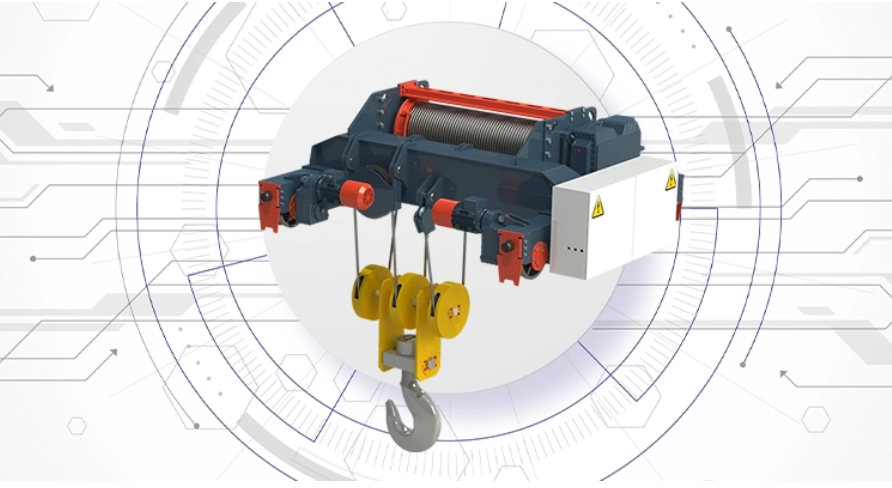
A crane hook block is a mechanical lifting component that connects the load to the crane’s wire rope system through a combination of hooks, sheaves and supporting components.
Although it may look like a relatively simple part of the crane, a hook block is not just a steel hook.
Depending on the project, the system may include:
Crane hook
Sheaves
Sheave shafts
Bearings
Side plates
Rope grooves
Hook connection components
Safety components
These elements work together as part of the crane’s Hoisting Unit.
EserVinç lists the hook and sheaves among the main components of its Hoisting Units.
Internal link: EserVinç Hoisting Units
What Does a Hook Block Do on a Crane?
The primary function of the hook block is to create a controlled mechanical connection between the load and the crane’s hoisting mechanism.
The motor and gearbox rotate the rope drum.
The steel wire rope then:
Leaves the drum
Passes through the sheaves
Supports the hook block
Moves the hook upward or downward
The basic lifting chain can therefore be represented as:
Motor → Gearbox → Drum → Wire Rope → Sheave → Hook Block → Load
For this reason, it is not sufficient to evaluate only:
Motor power
Hook capacity
The complete lifting system should be mechanically compatible.
Are the Crane Hook and Hook Block the Same Thing?
No.
The crane hook is the load-bearing component to which the load or lifting attachment is connected.
The hook block is a broader mechanical assembly that may include:
Hook
Sheaves
Supporting body
Shafts and bearings
Wire rope arrangement
Therefore:
Hook Capacity
and
Hook Block Design
do not mean the same thing.
What Do the Sheaves in a Crane Hook Block Do?
A crane sheave guides the wire rope along its designed path within the hoisting system.
The sheaves allow the wire rope to operate between the drum and the hook block according to a defined arrangement.
The number of sheaves and the rope routing can influence:
Lifting system geometry
Lifting speed
Hook block dimensions
Rope loading
Overall hoisting arrangement
This means:
“More sheaves are always better.”
is not a correct engineering assumption.
The appropriate sheave arrangement should be selected according to the actual crane design.
What Is Reeving?
In crane engineering, reeving describes the way the wire rope is routed between the drum and the sheaves.
It can also be described as:
Wire rope routing
Rope arrangement
Rope fall arrangement
The reeving system determines:
Which sheaves the rope passes through
How the hook block moves
How the load is distributed across the rope parts
For this reason, reeving is one of the fundamental design elements of a crane hoisting mechanism.
Changing the reeving arrangement on an existing crane should not be considered simply a matter of:
“Running the rope through the sheaves differently.”
The following should be evaluated together:
Drum
Sheaves
Hook block
Wire rope
Hoisting unit
Why Is the Number of Rope Parts Important?
The hook block is supported through multiple rope parts depending on the selected reeving arrangement.
However, simplified assumptions such as:
“If there are four rope parts, crane capacity automatically doubles.”
should be avoided.
The actual capacity of the lifting system also depends on:
Wire rope construction
Hoisting unit
Drum
Sheave diameters
Connection components
Hook block
Motor and gearbox
Brake system
Therefore, changing the number of rope parts alone does not automatically increase the crane’s rated lifting capacity.
How Is a Hook Block Selected According to Crane Capacity?
Crane capacity is one of the primary parameters in hook block selection.
However, it is not the only criterion.
The following should also be considered:
Duty class
Daily operating cycles
Lifting height
Lifting speed
Below-the-hook equipment
Environmental conditions
Process requirements
For example, two cranes may both have a rated capacity of 20 tons.
The first crane may perform only a few maintenance lifts per day.
The second may operate:
Three shifts
As part of a production process
With a high number of lifting cycles
The operating demands on their hook blocks and sheaves are therefore not identical.
Is the Self-Weight of the Hook Block Important?
Yes.
The hook block itself is part of the moving mass handled by the hoisting system.
Especially at higher capacities, the combined weight of:
Hook block body
Sheaves
Hook
Connection components
can become significant.
This self-weight is therefore part of the mechanical and dynamic design of the hoisting system.
Can a Large Hook Block Reduce Lifting Height?
Yes.
This is particularly important in Overhead Bridge Crane projects.
As the physical height of the hook block increases, the maximum position that the hook can reach relative to:
Main crane structure
Hoisting trolley
Upper supporting structure
may change.
Therefore, information such as:
“Our factory is 8 meters high.”
is not enough by itself.
The required maximum hook height should also be known.
Internal link: How Is Overhead Bridge Crane Lifting Height Determined?
Does the Hook Block Affect Headroom?
Yes.
Headroom is related to the geometric space between the supporting crane structure and the highest usable hook position.
If the hook block becomes larger or the Hoisting Unit geometry changes, the available upper approach can also change.
This is particularly important in:
Low-roof factories
Crane installations in existing buildings
Loads that must pass over tall machinery
Applications requiring maximum lifting height
For this reason, hook block dimensions should be considered during crane layout planning.
Is a Smaller Hook Block Always Better?
No.
A compact hook block may improve available lifting height.
However, the system cannot be selected only because it is physically smaller.
The hook block must be suitable for:
Capacity
Number of sheaves
Reeving arrangement
Structural requirements
Duty class
The goal should therefore not be:
“The smallest possible hook block.”
The correct objective is:
“The most suitable hook block for the required capacity and crane geometry.”
How Is a Hook Block Selected for an Overhead Bridge Crane?
An Overhead Bridge Crane is one of the most widely used industrial lifting systems.
Hook block selection can depend on:
Single Girder or Double Girder design
Hoisting trolley geometry
Capacity
Lifting height
Duty class
Hook approach requirements
EserVinç’s Overhead Bridge Crane range includes both Single Girder and Double Girder systems.
Internal link: EserVinç Overhead Bridge Cranes
Can Hook Blocks Differ Between Single Girder and Double Girder Cranes?
Yes.
When the crane architecture changes, the geometry of the hoisting trolley may also change.
Single Girder Overhead Bridge Crane
The Hoisting Unit is generally arranged according to the geometry of a single main girder.
Double Girder Overhead Bridge Crane
The hoisting trolley may travel on two main bridge girders.
This can change:
Hoisting unit layout
Drum position
Reeving geometry
Hook block working envelope
Therefore, the hook block should not be selected independently of the crane structure.
Is Hook Block Selection Different for a Gantry Crane?
The basic lifting principle is similar, but the operating environment of a Gantry Crane may be different.
Gantry Cranes are frequently used in:
Outdoor yards
Precast concrete facilities
Steel storage areas
Marble and stone facilities
Heavy-load handling applications
For this reason, hook block and sheave selection may also need to consider:
Outdoor conditions
Dust
Moisture
Corrosion
Operating intensity
Internal link: EserVinç Gantry Cranes
Why Is Hook Block Reach Important on a Cantilever Gantry Crane?
On a cantilever Gantry Crane, the hoisting trolley may move outside the main gantry span.
In this situation, asking only:
“How long is the cantilever?”
is not sufficient.
It is also important to know:
How far the center of the hook block reaches beyond the gantry leg
Mechanical trolley approach distance
Hook block geometry
The hook block therefore becomes part of the crane’s working area planning.
Why Can the Hook Block Be More Critical on Process Cranes?
A Process Crane operates as an integral part of production.
Examples include:
Ladle Crane
Charging Crane
Tundish Crane
Billet Handling Crane
Scrap Handling Crane
In these applications, the hoisting system can operate:
Frequently
Repetitively
Under intensive production cycles
Therefore, hook block selection should not be based only on:
Rated capacity
Physical dimensions
The following should also be evaluated:
Actual operating cycles
Load spectrum
Environmental conditions
Process criticality
Internal link: EserVinç Process (Special) Cranes
What Is the Difference Between a Hook Block and Below-the-Hook Equipment?
These two concepts are often confused.
Hook Block
The hook block is a permanent component of the crane’s Hoisting Unit.
Below-the-Hook Equipment
This refers to equipment attached to the hook according to the type of load being handled.
Examples include:
Spreader beam
C-Hook
Magnet
Orange peel grab
Bucket
Special lifting attachment
In simple terms:
Hook Block → Part of the crane
Below-the-Hook Equipment → Attachment connected to the hook for a specific load
How Does Below-the-Hook Equipment Affect the Hook Block?
When heavy equipment such as:
Spreader beams
Magnets
C-Hooks
Special attachments
is used, the total suspended load carried by the hook block increases.
For example:
Product weight: 15 tons
Spreader beam: 2 tons
Connection equipment: 500 kg
The actual suspended load becomes approximately 17.5 tons.
For this reason, below-the-hook equipment must be included when evaluating:
Crane capacity
Hook block
Hoisting Unit
Can a Crane Hook Rotate?
Some hook designs use a bearing connection that allows the hook to rotate about its axis.
EserVinç states in its Hoisting Unit information that the hook can be bearing-supported and capable of 360-degree rotation.
However, this does not mean:
the load should be allowed to rotate freely and uncontrollably.
Load orientation and rotation requirements should be planned according to the actual operating process.
What Does a Hook Safety Latch Do?
A hook safety latch helps reduce the risk of a suitable sling or lifting connection unintentionally leaving the hook opening.
However, a safety latch does not make the following situations safe:
Incorrect slinging
Incorrect lifting angles
Overloading
Improper load attachment
The crane hook should always be used together with appropriate lifting equipment and correct operating practices.
Why Is Crane Hook Deformation Important?
The crane hook directly carries the suspended load.
For this reason, findings such as:
Permanent deformation
Suspected cracking
Significant change in hook throat opening
Abnormal wear on load-bearing surfaces
Problems in the rotation mechanism
may require technical inspection.
The decision to continue using or replace the hook should not be based only on an informal visual judgement.
It should follow:
Qualified technical inspection
Manufacturer criteria
Applicable technical requirements
Can Sheave Wear Affect the Wire Rope?
Yes.
If the:
Sheave groove
Sheave rotation
Bearings
Alignment
are not in good condition, the operating behavior of the wire rope may be affected.
For example, if:
The sheave does not rotate correctly
The groove has worn abnormally
A bearing problem exists
Alignment is incorrect
the rope may experience irregular contact and wear.
Therefore, when a crane repeatedly develops rope problems, it may not be sufficient to simply say:
“Replace the wire rope.”
The sheaves inside the hook block should also be inspected.
Should the Hook Block Be Inspected When Installing a New Wire Rope?
Yes.
When a new wire rope is installed, it is good practice to evaluate the related components together.
The inspection may include:
Drum
Rope guide
Sheaves
Hook block
Reeving arrangement
Installing a new rope on worn sheaves may negatively affect the service life of the new rope.
Why Should a Crane Sheave Rotate Freely?
The function of the sheave is to change the wire rope direction in a controlled manner.
If the sheave does not rotate properly and the rope instead slides over its surface, this may increase:
Friction
Surface wear
Heat
For this reason, the following should be included in maintenance evaluation:
Sheave bearings
Sheave rotation
Groove condition
Why Can a Hook Block Tilt to One Side?
If a hook block appears tilted or unbalanced, several possible causes may need to be investigated.
These can include:
Irregular reeving
Sheave problems
Off-center loading
Uneven use of lifting attachments
Rather than forcing the hook block into position, the root cause should be identified.
Why Does a Hook Block Rotate?
Hook block rotation may be influenced by:
Load geometry
Wire rope construction
Reeving
Lifting conditions
Certain applications, particularly those involving:
Long lifting heights
Particular wire rope constructions
Loads that tend to rotate
may require additional technical evaluation.
What Should Be Inspected During Hook Block Maintenance?
Inspection requirements should follow the crane manufacturer’s instructions and actual operating conditions.
Typical inspection points may include:
Hook
Sheave grooves
Sheave rotation
Bearings
Pins and connections
Safety latch
Side plates
Rope routing
Abnormal noise or vibration
The objective is to inspect the hook block as a complete mechanical system, not merely the visible hook.
When Should a Hook Block Be Replaced?
There is no universal rule such as:
“Replace the hook block every X years.”
Replacement requirements depend on:
Wear
Deformation
Damage or cracking indications
Sheave and bearing condition
Operating intensity
Manufacturer criteria
Technical inspection results
A high-cycle Process Crane and a maintenance crane used only a few times per month should not automatically follow the same calendar-based replacement interval.
Should the Hook Block Be Replaced During a Capacity Upgrade?
Increasing crane capacity cannot be achieved simply by changing the hook block.
Likewise, installing a higher-capacity hook block does not automatically increase the crane’s rated capacity.
A capacity upgrade should evaluate the complete system, including:
Main structure
Hoisting motor
Gearbox
Brake
Drum
Wire rope
Sheave system
Hook block
Wheels
Rails
Building supporting structure
Therefore:
Larger Hook ≠ Higher Crane Capacity
Can the Hook Block Be Replaced During Crane Modernization?
Yes.
During the modernization of an existing:
Overhead Crane
Travelling Crane
Gantry Crane
Process Crane
the hook block can be replaced if justified by technical inspection.
However, the first question should be:
Why is the current system no longer suitable?
Is the issue:
Capacity?
Wear?
Lifting height?
Spare parts availability?
A new process requirement?
The root cause should be identified before selecting the replacement system.
What Determines Crane Hook Block Prices?
A crane hook block price is not determined by tonnage alone.
Cost may be influenced by:
Capacity
Hook type
Number of sheaves
Sheave dimensions
Reeving arrangement
Duty class
Hook block geometry
Project-specific manufacturing
Environmental conditions
For this reason, asking:
“What is the price of a 10-ton crane hook block?”
does not provide enough technical information for an accurate quotation.
What Information Is Required for a Hook Block Quotation?
For a proper technical evaluation, the following information should be prepared:
Crane Type
Is it an Overhead Bridge Crane, Gantry Crane, Process Crane, or another crane type?
Capacity
What is the maximum suspended load?
Hoisting Unit
Are the model and technical specifications of the existing hoist or Hoisting Unit available?
Wire Rope
What are the rope diameter, construction and current reeving details?
Sheave Arrangement
How many sheaves are installed in the current hook block?
Lifting Height
What is the operating range of the hook?
Operating Intensity
How many lifting cycles are performed per day?
Below-the-Hook Equipment
Are spreader beams, magnets, C-Hooks or other special attachments used?
Current Problem
Is the issue related to:
Wear
Suspected cracking
Sheave problems
Hook block rotation
Lifting height limitations
This information allows the system to be evaluated correctly rather than treating the request as a simple spare-part quotation.
Most Common Mistakes in Hook Block Selection
Common mistakes include:
Selecting the hook block only according to tonnage
Ignoring the reeving arrangement
Ignoring sheave diameters
Failing to calculate lifting height loss
Ignoring below-the-hook equipment weight
Not specifying operating cycles
Assuming Single Girder and Double Girder systems have identical geometry
Ordering a new hook block without measuring the existing arrangement
Assuming a larger hook increases crane capacity
SEO and GEO: Which Hook Block Questions Should Be Targeted?
This content can be optimized not only for conventional Google SEO but also for queries asked through ChatGPT, Gemini and other AI-powered search systems.
Important target questions include:
What is a crane hook block?
How does a crane hook work?
What does a crane sheave do?
What is crane reeving?
How is a crane wire rope system selected?
Does the hook block affect lifting height?
How is an Overhead Crane hook block selected?
Why does a Travelling Crane hook rotate?
How is a Gantry Crane hook block selected?
Why is a Process Crane hook block different?
When should a crane hook be replaced?
Why does a hook block tilt?
Why do crane sheaves wear?
How is a 10-ton hook block selected?
Crane hook block manufacturer Turkey
Crane manufacturer Konya
Answering these queries directly creates strong information blocks for both SEO and GEO.
EserVinç Hook, Sheave and Hoisting Unit Solutions
Within EserVinç’s Hoisting Unit product architecture, the following components are treated as parts of the same lifting system:
Hoisting motor and gearbox
Drum
Hook and sheaves
Rope guide
Electrical equipment
Overload limiting system
Wheel blocks
For this reason, the hook block should not be evaluated as an isolated component.
The complete engineering chain is:
Motor → Gearbox → Drum → Wire Rope → Sheave → Hook Block → Below-the-Hook Equipment → Load
EserVinç Internal Links
How Is Overhead Bridge Crane Lifting Height Determined?
Crane Maintenance and Periodic Inspection
This internal-link structure connects the Overhead Bridge Crane, Gantry Crane, Process Crane, Overhead Crane and Travelling Crane topic clusters through the Hoisting Unit content architecture.
Frequently Asked Questions
What is a crane hook block?
A crane hook block is a mechanical Hoisting Unit component that combines the hook, sheaves and related parts to connect the suspended load to the wire rope system.
Are a crane hook and hook block the same thing?
No. The hook is the load-bearing component where the load is attached. The hook block is the larger assembly that includes the hook, sheaves and related mechanical elements.
What does a crane sheave do?
A crane sheave changes the direction of the wire rope and supports the crane’s reeving arrangement.
What is reeving?
Reeving is the routing arrangement of the wire rope between the drum and the sheaves.
Does the hook block affect lifting height?
Yes. The structural height of the hook block can influence the maximum hook position and the usable lifting height.
Is a smaller hook block always better for an Overhead Crane?
No. It must be suitable for the crane capacity, reeving arrangement and duty class.
Can changing the hook block increase crane capacity?
No. Installing a larger-capacity hook block does not automatically increase the overall capacity of the crane.
Why does a hook block rotate?
Wire rope construction, reeving, load geometry and lifting conditions can influence hook block rotation. Repeated or abnormal rotation should be technically evaluated.
When should a crane hook be replaced?
Replacement should be based on wear, deformation, damage indications and technical inspection results rather than a universal fixed time interval.
Does a Gantry Crane use a different hook block?
The hook block should be selected according to project capacity, duty class, operating environment and Hoisting Unit geometry.
Why is the hook block important on a Process Crane?
Process Cranes may operate at high cycle rates and as a direct part of production, so the hook block should be selected according to actual operating intensity.
Correct Hook Block Selection Requires More Than Knowing the Hook Capacity
Simply saying:
“We have a 20-ton hook.”
does not define the complete lifting system.
Proper engineering also needs to answer:
What is the Hoisting Unit capacity?
Which wire rope is used?
What is the reeving arrangement?
How many sheaves are installed?
What is the physical height of the hook block?
Is the available lifting height sufficient?
How many cycles are performed per day?
Will a spreader beam or magnet be connected to the hook?
Is the crane an Overhead Bridge Crane, Gantry Crane or Process Crane?
A hook block is not simply a steel component hanging at the bottom of the crane. It is a fundamental part of the Hoisting Unit, operating together with the motor, gearbox, drum, wire rope and sheave system.
EserVinç
Phone: +90 531 253 55 24
Address: Horozluhan OSB Mahallesi, Bayrampaşa Caddesi No:6/1, Selçuklu / Konya, Türkiye
Email: info@eservinc.com